For the last two decades, CX, Insights, and Analytics professionals have helped companies move from not knowing their customers to understanding them, taking action on insights, and embedding customer-centric culture throughout the business.
Today, teams responsible for measuring and improving Customer Experience face greater consumer demand for personalization and increased organizational pressure to demonstrate a clear connection to ROI and justify CX metrics.
To help our clients navigate these challenges and opportunities, commonFont created an expanded framework for transformative CX. Our framework builds on traditional CX practices to set organizations up for success in the current and future environment.

Traditional vs. Transformative CX
Traditional CX programs have focused on collecting feedback (both solicited and unsolicited), analyzing it through dashboards and reports, and driving actions like closing the loop with individual customers (inner loop) or improving processes (outer loop). This approach has been important for driving positive enterprise-wide outcomes, such as alignment around experience-based metrics. However, traditional methodologies are primarily limited to responding to existing customer feedback, rather than proactively driving positive experience improvements.
Meanwhile, we have entered a new era: the experience economy. In this era, brands compete fiercely based on the experiences they deliver and the human relationships and loyalty those experiences build. Customers expect ever more personalized and higher-touch interactions. McKinsey reports that 71% of consumers expect companies to deliver personalized interactions, and three-quarters will switch if they don’t like their experience.¹
Simultaneously, organizations are demanding more from CX; they want clearer proof points, greater ROI, and more tangible impact beyond just reporting metrics. The tools and techniques of traditional CX, while still relevant, are producing diminishing returns and impact in this changing landscape. According to Forrester, “The ‘low-hanging fruit’ of easy CX wins has been picked,” and organizations that maintain the status quo cede ground to those that prioritize strategic investment in better CX.²
The good news? Transforming CX isn’t about abandoning everything you’ve built; it’s about adding new capabilities to your strong foundation. It’s not a binary choice between modern and legacy practices, but an incremental process of innovation and experimentation without disrupting the significant gains already realized through traditional methods.
To guide our clients through the necessary progress and change, commonFont’s framework for transformative experiences expands on and amplifies the traditional CX practices of “Listen, Analyze, Act” in this new era:
commonFont’s Framework for Transformative CX: Listen, Unify, Analyze, Recall, Act
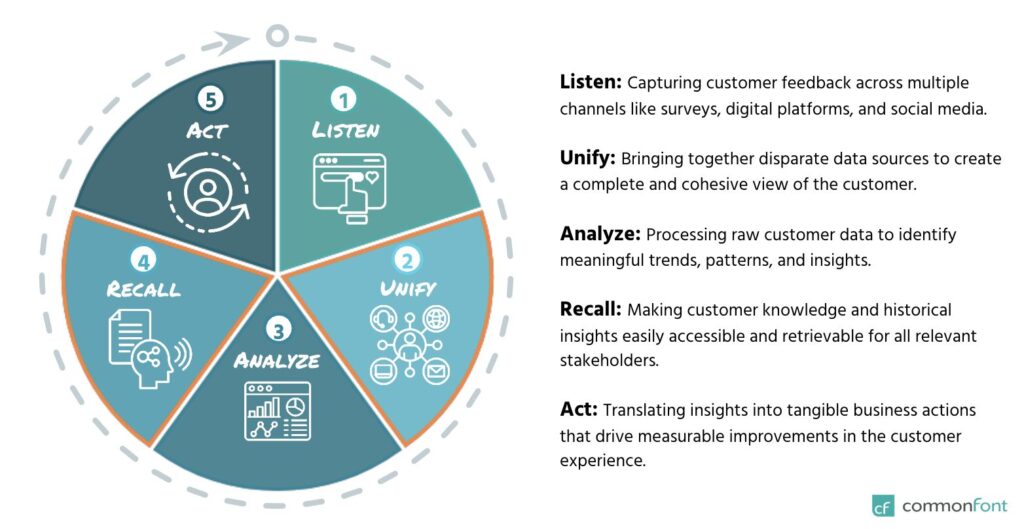
1. Transforming “Listen”
Traditional listening often focused on static surveys and established feedback channels. Transformative listening is much broader. It’s a holistic collection exercise that includes all relevant customer data and new techniques, such as conversational surveys, that start an ongoing dialogue with customers that can be further tuned through AI-based tools. This means incorporating direct sources, observed sources, behaviors, and preferences, and adapting as new data sources emerge.
2. Adding “Unify”
In our framework, we’ve introduced a critical new step: unifying diverse sources of customer data. Omnichannel data needs to be coalesced and connected to the individual humans (the customers) it describes. Traditional technologies optimized data collection for analysis in siloed tools, not for understanding individual customers across holistic journeys. Unification ensures we move beyond analyzing trends in big data sets to understanding the data in relation to the specific customers it represents.
3. Transforming “Analyze”
Traditional analysis often occurs within the silos where data was collected: digital data in a digital platform, survey data in a survey platform, contact center data in a contact center platform. In contrast, unified, aggregated data allows us to apply sophisticated and powerful advanced analytics tools like AI and machine learning. This allows us to make sense of disparate data sets, derive insights, and understand how individual customer relationships and journeys evolve over time
4. Adding “Recall”
Having analyzed data at the customer level and derived understanding, there’s another crucial new step before acting: recalling everything relevant about the customer and your relationship with them that is pertinent to the interaction unfolding in real time. This is analogous to how humans access knowledge and context about a relationship during a conversation, and it is a highly human component of delivering compelling, emotionally resonant experiences.
5. Transforming “Act”
Traditionally, ‘acting’ on customer feedback meant measuring after the fact, closing survey loops, and publishing metrics. The goal was to inspire business action, often without guaranteed results. With analysis at a customer level and the ability to recall context, in our updated model, we are set up to understand what individual customers might want or prefer, enabling prediction and anticipation. This transforms action into anticipating and curating experiences in real-time, allowing for personalized and tailored interactions and journeys, creating the kind of experience a human might deliver
The Transformative CX Advantage
Our expanded model moves from traditional “Listen, Analyze, Act” to a process involving holistic listening, unifying data around customers, advanced analysis, real-time recall, and anticipatory action, equipping organizations with capabilities that traditional CX frameworks and processes may not achieve. These capabilities include prediction, personalization, and prescriptive actions and workflows. Transformative CX can even help organizations take cost out of serving or acquiring a customer while adding value, often more effectively and at greater scale than traditional methods.
Most organizations already have a head start on this journey thanks to their investments in traditional CX. The key is understanding your current strengths, assessing where you are, and charting a roadmap to build on that foundation.
Ready to take the next step? Our team specializes in working with you to assess your current strengths, identify opportunities, and develop a strategy and roadmap to move into the Transformative CX future.
Embracing this additive approach allows CX, Insights, and Analytics teams to expand impact and strengthen customer relationships without disrupting the successful pillars they’ve already built into their programs. It’s an exciting journey of evolution, not revolution.
² https://www.forrester.com/blogs/predictions-2025-customer-experience-cx/